What Is the Lifespan of a 12x30.5x4 4-Inch Air Filter?
Most homeowners replace their air filter on a gut feeling — or a reminder they've been snoozing for two weeks. With a 12x30.5x4 air filter, that guesswork is unnecessary. This size lasts 6 to 9 months in most households, and knowing what shortens or extends that range is the difference between a protected home and one quietly circulating air through a spent filter.
After manufacturing filters for over a decade and serving more than two million households, we've seen the same pattern repeat: homeowners either wait too long because they assume a 4-inch filter is invincible, or they replace it too early and waste money. Neither is right. This guide gives you the actual variables so you can make the call confidently.
TL;DR Quick Answers
How long does a 12x30.5x4 4-inch air filter last?
A 12x30.5x4 4-inch filter lasts 6 to 9 months in most standard households. Homes with pets or allergy sufferers should plan for 3 to 5 months. In wildfire or high-pollution conditions, replace every 8 to 12 weeks.
What's the best MERV rating for a 12x30.5x4 air filter?
MERV 11 is the right choice for most households — it captures 95% of particles including pet dander and fine dust without restricting airflow. MERV 8 suits cleaner homes with no pets. MERV 13 is best for allergy, asthma, or smoke-exposed households.
How is a 4-inch air filter different from a 1-inch filter?
A 4-inch filter holds far more filtration media, which means more surface area for particle capture and a much longer lifespan. A 1-inch filter typically lasts 60 to 90 days. A 12x30.5x4 4-inch filter lasts 6 to 9 months.
When should I replace my 12x30.5x4 filter if I have pets?
Replace every 5 to 7 months with one pet in the home, and every 3 to 5 months with multiple pets. Do a quick visual inspection monthly during heavy shedding seasons and replace early if the media looks gray or loaded with hair and dander.
Top Takeaways
A 12x30.5x4 4-inch air filter lasts 6 to 9 months in most standard households — significantly longer than a 1-inch filter in the same conditions.
Homes with pets, allergy sufferers, or high HVAC usage should plan for 3-to-5-month replacement cycles.
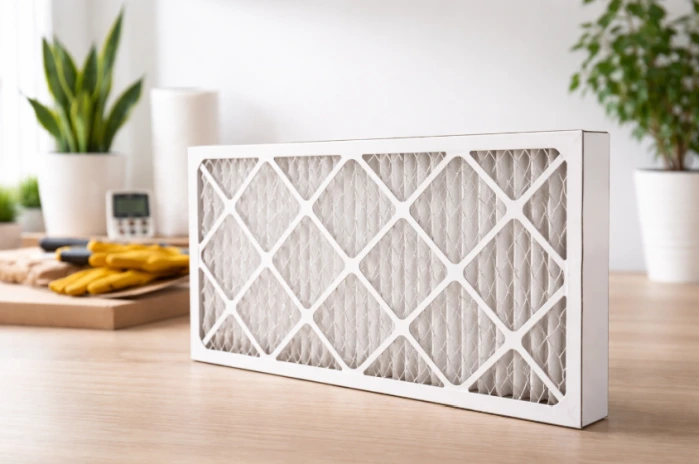
The actual size of a 12x30.5x4 filter is 12.00 x 30.50 x 3.63 inches. A proper fit is essential for full filtration performance.
MERV 8, MERV 11, and MERV 13 options are all available in this size — precision-cut and American-made by Filterbuy.
A monthly visual inspection is the most reliable early warning system, regardless of your expected filter lifespan.
The EPA finds that indoor air is often 2 to 5 times more polluted than outdoor air. Your filter isn't optional — it's doing real work every day.
How Long Does a 12x30.5x4 4-Inch Air Filter Last?
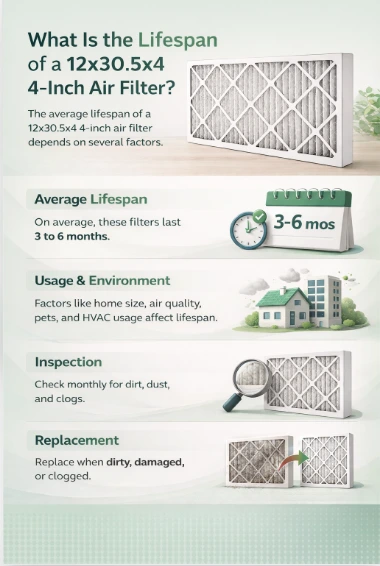
Six to nine months. That's the realistic range for most households under normal conditions, and it's not a marketing claim — it's a function of media volume. A 4-inch filter holds significantly more filtration material than a 1-inch filter, which means more surface area to capture particles before the media becomes saturated and starts restricting airflow.
Here's how lifespan breaks down by household type:
Standard household, no pets, no allergy concerns: 6 to 9 months
One pet in the home: 5 to 7 months
Multiple pets or allergy sufferers in the household: 3 to 5 months
Active wildfire season or consistently poor outdoor air quality: 8 to 12 weeks
One sizing note: the nominal size of this filter is 12x30.5x4. The actual dimensions are 12.00 x 30.50 x 3.63 inches. Nominal is the rounded number printed large on the filter frame. Actual is the precise physical measurement. Both matter. A filter that's too small leaves gaps where unfiltered air bypasses the media entirely. Too large and it won't seat correctly in the slot.
What Factors Affect the Lifespan of a 12x30.5x4 Filter?
MERV Rating
MERV stands for Minimum Efficiency Reporting Value — the industry-standard scale developed under ASHRAE Standard 52.2 to measure how effectively a filter captures particles of different sizes. The 12x30.5x4 comes in MERV 8, MERV 11, and MERV 13. Under standard household conditions, all three comfortably reach the 6-to-9-month range in this 4-inch format because the extra depth offsets the denser filtration media. Push any of them hard — wildfire smoke, multiple pets, high indoor dust — and MERV 13 will saturate faster than MERV 8, simply because it's capturing more.
Pets and Pet Dander
Pet hair and dander load a filter faster than almost anything else in a typical home. One shedding dog or cat: plan for 5 to 7 months and do a quick visual check every month. Two or more pets? Expect 3 to 5 months, especially during seasonal shedding.
Allergy and Asthma Households
Don't wait for visible soiling as your only replacement signal. In homes where someone manages allergies or asthma, a filter that looks mostly clean can still carry enough fine particles to affect indoor air quality in real ways. Replace every 3 to 5 months regardless of appearance, and upgrade to MERV 11 or MERV 13 where the budget allows.
Air Quality and Wildfire Smoke
During active wildfire events, the EPA recommends upgrading to MERV 13 or higher and replacing filters more frequently. Smoke particles are fine enough to saturate mid-range filters fast. If your region runs wildfire seasons or consistently ranks high on the Air Quality Index, treat your 12x30.5x4 as a 60-to-90-day resource during those windows — not a 6-month one.
HVAC Usage and System Run Time
A system running 8-plus hours a day cycles more air — and more particles — through your filter than one running intermittently. Homes in warm Southern climates, or those on year-round comfort programs, should factor that into their replacement schedule. Higher run time means shorter intervals.
MERV Rating Comparison: Which 12x30.5x4 Filter Is Right for Your Home?
MERV 8 — Standard Protection (90% Particle Capture)
MERV 8 captures 90% of airborne particles including common household dust, pollen, dust mites, and mold spores. It's the right choice for homes without pets or significant respiratory concerns, and it delivers a 6-to-9-month lifespan without putting unnecessary strain on your HVAC system's airflow.
MERV 11 — Superior Pet and Allergy Defense (95% Particle Capture)
MERV 11 captures 95% of airborne particles, adding fine pet dander, smog, and smaller dust particles to what MERV 8 already handles. It's our most popular rating for households with pets. The electrostatically charged media attracts and holds microscopic particles without meaningfully restricting airflow. Plan for a 5-to-7-month replacement cycle.
MERV 13 — Optimal Smoke and Allergy Defense (98% Particle Capture)
MERV 13 captures 98% of airborne particles — including bacteria and virus-carrying particles. It's the right call for households managing significant allergies, asthma, immune concerns, or frequent smoke exposure. Under average conditions, it runs the full 6-to-9-month range. Under heavy particle load, plan for 3 to 5 months.
Signs It's Time to Replace Your 12x30.5x4 Air Filter
Your replacement calendar is a starting point, not a guarantee. These five signals tell you the filter needs to come out — regardless of what the date says:
The filter media looks gray or visibly packed with debris.
Airflow from your vents feels weaker than normal, or rooms feel uneven in temperature or humidity.
Energy bills have crept up without a meaningful change in usage or season.
Dust accumulates on surfaces faster than usual between your regular cleanings.
Musty or stale odors are coming from the vents when the system kicks on.
In our experience manufacturing filters for over a decade, a quick monthly visual check is the single most effective habit a homeowner can build. Most filter problems show up on the media long before they appear as system failures or climbing energy bills.
"After manufacturing millions of filters, the pattern we see most isn't a filter that gave out early — it's a household that outgrew its MERV rating without realizing it. Match the filter to your actual air load, and a 12x30.5x4 will consistently hit the top end of its range."
7 Essential Resources
These are the sources we reference when manufacturing filters, training our team, and developing content for the homeowners we serve. Every link below goes to a verified government or standards organization.
1. What Is a MERV Rating? — U.S. Environmental Protection Agency
The EPA's official explanation of the MERV scale — what it measures, how filters are tested against it, and why rating selection matters for indoor air quality decisions. https://www.epa.gov/indoor-air-quality-iaq/what-merv-rating
2. Indoor Air Quality — EPA Report on the Environment
The EPA's data report on indoor air quality across the U.S., including the finding that Americans spend approximately 90% of their time indoors and that indoor pollutant concentrations are often 2 to 5 times higher than outdoor levels. https://www.epa.gov/report-environment/indoor-air-quality
3. The Inside Story: A Guide to Indoor Air Quality — U.S. EPA
A homeowner-facing reference covering indoor pollution sources, health effects, and practical steps including filtration and ventilation guidance. https://www.epa.gov/indoor-air-quality-iaq/inside-story-guide-indoor-air-quality
4. Air Conditioner Maintenance — U.S. Department of Energy
The DOE's official HVAC maintenance guide. Confirms that replacing dirty filters is one of the highest-impact routine maintenance actions available to homeowners. https://www.energy.gov/energysaver/air-conditioner-maintenance
5. Energy Saver 101: Home Cooling — U.S. Department of Energy
The source for the DOE's finding that clean air filters can reduce air conditioner energy consumption by 5 to 15%. Essential context for understanding the real financial cost of running a clogged filter. https://www.energy.gov/energysaver/articles/energy-saver-101-home-cooling-infographic
6. Biological Contaminants and Indoor Air Quality — U.S. EPA
The EPA's guide to biological indoor pollutants: bacteria, viruses, mold, dust mites, pollen, and pet allergens. Directly relevant to MERV selection — MERV 13 is the minimum for capturing bacteria and virus-carrying particles. https://www.epa.gov/indoor-air-quality-iaq/biological-contaminants-and-indoor-air-quality
7. ASHRAE Standard 52.2 — Method of Testing General Ventilation Air-Cleaning Devices
The engineering standard that defines the MERV rating system used across the air filtration industry, published by the American Society of Heating, Refrigerating and Air-Conditioning Engineers. https://www.ashrae.org/technical-resources/bookstore/standard-52-2
3 Statistics
These figures come from verified U.S. government sources. They put the conversation about air filters into the health and financial context most homeowners don't see until something goes wrong.hvac
Americans spend approximately 90% of their time indoors.
Source: U.S. EPA — Indoor Air Quality (Report on the Environment) https://www.epa.gov/report-environment/indoor-air-quality
Indoor pollutant concentrations are often 2 to 5 times higher than typical outdoor concentrations.
Source: U.S. EPA — Indoor Air Quality (Report on the Environment) https://www.epa.gov/report-environment/indoor-air-quality
Clean air filters can lower air conditioner energy consumption by 5 to 15%.
Source: U.S. Department of Energy — Energy Saver 101: Home Cooling https://www.energy.gov/energysaver/articles/energy-saver-101-home-cooling-infographic
Final Thoughts and Opinion
We've manufactured air filters for over a decade and shipped them to more than two million households across the country. That track record gives us a clear opinion on the 12x30.5x4: it's one of the most undervalued upgrades a homeowner can make, and most people only discover that after they've spent years replacing 1-inch filters every 90 days.
Here's what most people miss. A 4-inch filter at MERV 8 outperforms a 1-inch filter at MERV 13 on longevity in most households — and does it without taxing your HVAC system's airflow. That translates to fewer replacements, lower long-term cost, and real protection for an expensive piece of home equipment that most homeowners don't think about until it breaks.
Our honest take on MERV for this size: MERV 11 is the right choice for most American households. It captures 95% of airborne particles, handles pet dander well, and doesn't restrict airflow. MERV 8 is smart and economical for homes without pets or respiratory concerns. MERV 13 is the correct call when respiratory health is genuinely in play.
What we tell every homeowner who asks: set a 90-day reminder and actually look at the filter when it goes off. Don't wait for symptoms — rising bills, weak airflow, dusty surfaces. The EPA data is unambiguous. The air inside your home is very likely more polluted than the air outside it. Your 12x30.5x4 is one of the few things actively standing between that reality and the people living in your home.
Frequently Asked Questions
How long does a 12x30.5x4 air filter last?
A 12x30.5x4 4-inch air filter typically lasts 6 to 9 months in a standard household. Homes with pets, allergy sufferers, or high HVAC usage should plan for 3 to 5 months. During active wildfire events or in consistently poor air quality environments, replace every 8 to 12 weeks.
What is the actual size of a 12x30.5x4 air filter?
The actual size is 12.00 x 30.50 x 3.63 inches. The 12x30.5x4 is the nominal size — the rounded number printed in larger font on the filter frame used for search and ordering purposes. Both numbers appear on every Filterbuy filter.
What MERV rating should I choose for my 12x30.5x4 filter?
MERV 8 works well for standard households without pets or respiratory concerns. MERV 11 is the most popular choice for homes with pets or mild allergy concerns — it captures 95% of airborne particles while maintaining strong airflow. MERV 13 is best for households managing asthma, significant allergies, or frequent exposure to wildfire smoke, capturing 98% of particles including bacteria and virus-carrying particles.
Does a 4-inch air filter last longer than a 1-inch filter?
Yes, significantly. A 4-inch filter holds far more filtration media than a 1-inch filter, which creates more surface area for particle capture before the filter becomes saturated and restricts airflow. A standard 1-inch pleated filter typically lasts 60 to 90 days. A 12x30.5x4 4-inch filter lasts 6 to 9 months under comparable household conditions.
How do I know when it's time to replace my 12x30.5x4 air filter?
Watch for these: the filter media appears gray or visibly packed with debris; airflow from your vents feels weaker than usual; energy bills have risen without a change in usage; dust is building up on surfaces faster than normal; or musty odors are coming from the vents when the system runs. Any one of these is reason enough to check the filter — not all five.
Is a 12x30.5x4 air filter compatible with my HVAC system?
The 12x30.5x4 works with HVAC systems, furnaces, air conditioners, and heat pumps that use a 4-inch filter cabinet or compatible return slot. If you're unsure, measure your filter slot opening — length, width, and depth — and round each dimension up to the nearest half-inch to confirm the nominal size. Filterbuy also offers a full custom filter program for non-standard sizing.
What happens if I wait too long to replace my 12x30.5x4 filter?
A saturated filter forces your HVAC system to work harder — something the U.S. Department of Energy connects to energy consumption increases of 5 to 15%. Over time, that added strain affects the blower motor and other components, potentially shortening equipment life. A clogged filter can also allow particles to bypass the media and accumulate on the evaporator coil, reducing both system efficiency and the quality of air moving through your home.
Your 12x30.5x4 Filter's Lifespan Starts With the Right MERV Rating — Find Yours Here
Now that you know how long a 12x30.5x4 4-inch air filter lasts and what drives that range, the next step is putting the right one in your system. Shop Filterbuy's precision-cut, American-made 12x30.5x4 filters in MERV 8, MERV 11, and MERV 13 — shipped free to your door: filterbuy.com/air-filters/12x30-5x4/
Learn more about HVAC Care from one of our HVAC solutions branches…
Filterbuy HVAC Solutions - Miami FL - Air Conditioning Service
1300 S Miami Ave Apt 4806 Miami FL 33130
(305) 306-5027
https://maps.app.goo.gl/Ci1vrL596LhvXKU79